
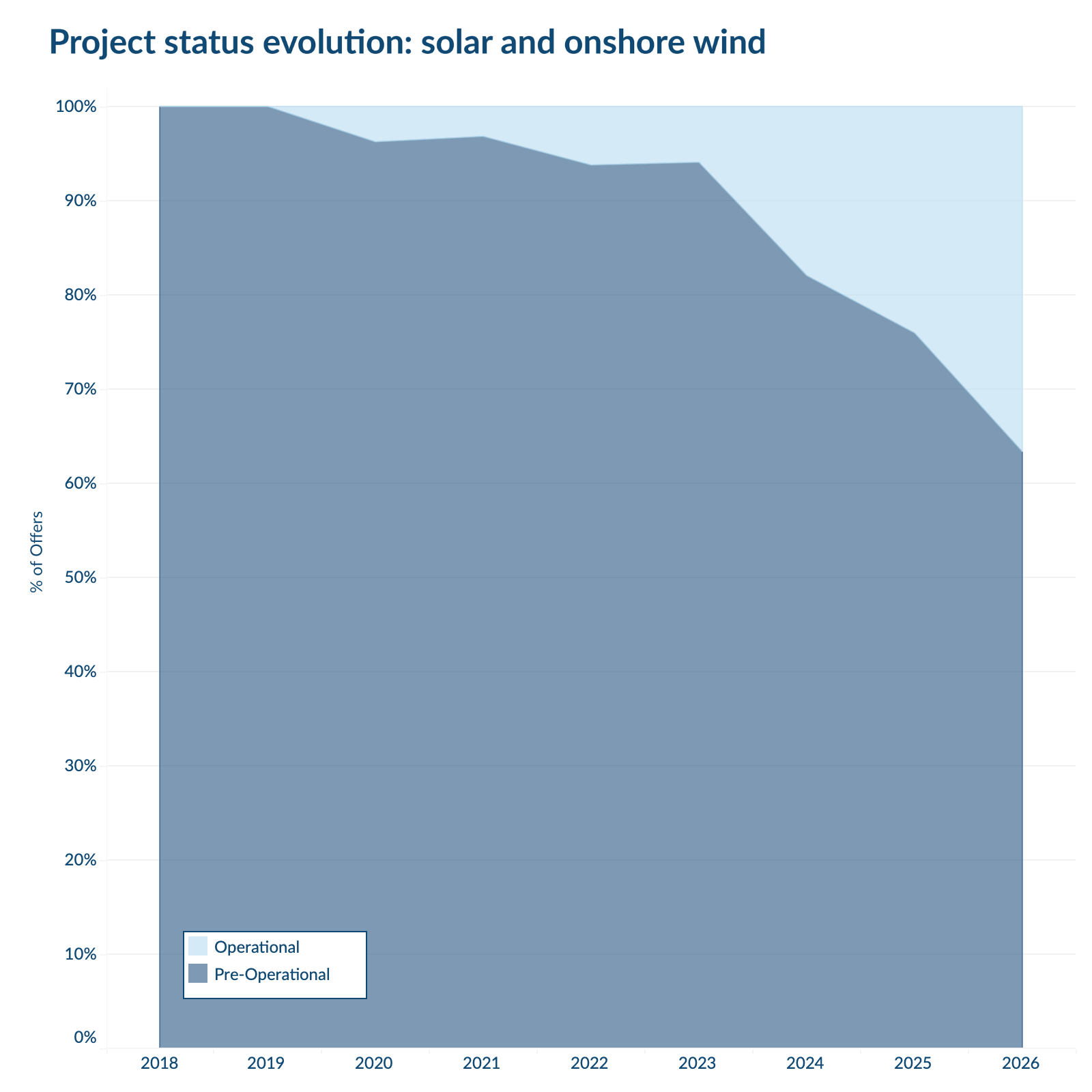
Operational projects are becoming increasingly central to the European PPA market, accounting for almost 40% of offers, as rising gas costs push buyers to lock in clean energy at speed.
That’s according to LevelTen Energy, whose latest quarterly PPA Price Index, published today, includes operational project data for the first time.
PPA offers for operational projects now make up almost 40% of all standalone European offers on the LevelTen Energy Platform, the world’s largest two-sided PPA marketplace. For wind offers, the figure is closer to 60%.
“Operational assets naturally lower risk and bring fewer development hurdles and permitting delays compared to new-build projects”, said Plácido Ostos, Director of European Analytics at LevelTen Energy. “For these reasons, they generally represent a faster, and often more cost-effective, route to power compared to new green energy infrastructure. For buyers focused primarily on speed and price over green additionality claims, deals tied to operational projects can be more attractive.”
Rising gas prices are prompting more large energy consumers to look for financial hedges ahead of winter. Operational assets can start delivering power and GOs immediately, with no construction, permitting, or grid-connection risk.
The report reveals little movement for European wind and solar PPA prices this quarter, as hybrid structures – which are gaining traction in the market – report a slight price drop.
The European-average 25th percentile (P25) for solar PPAs rose by 0.4% since last quarter, reaching 0.86 on LevelTen’s Continental Index, which tracks price changes across an eight-quarter window. This means the price of a typical solar PPA in Europe is now, in aggregate, at 86% of its Q3 2024 level.
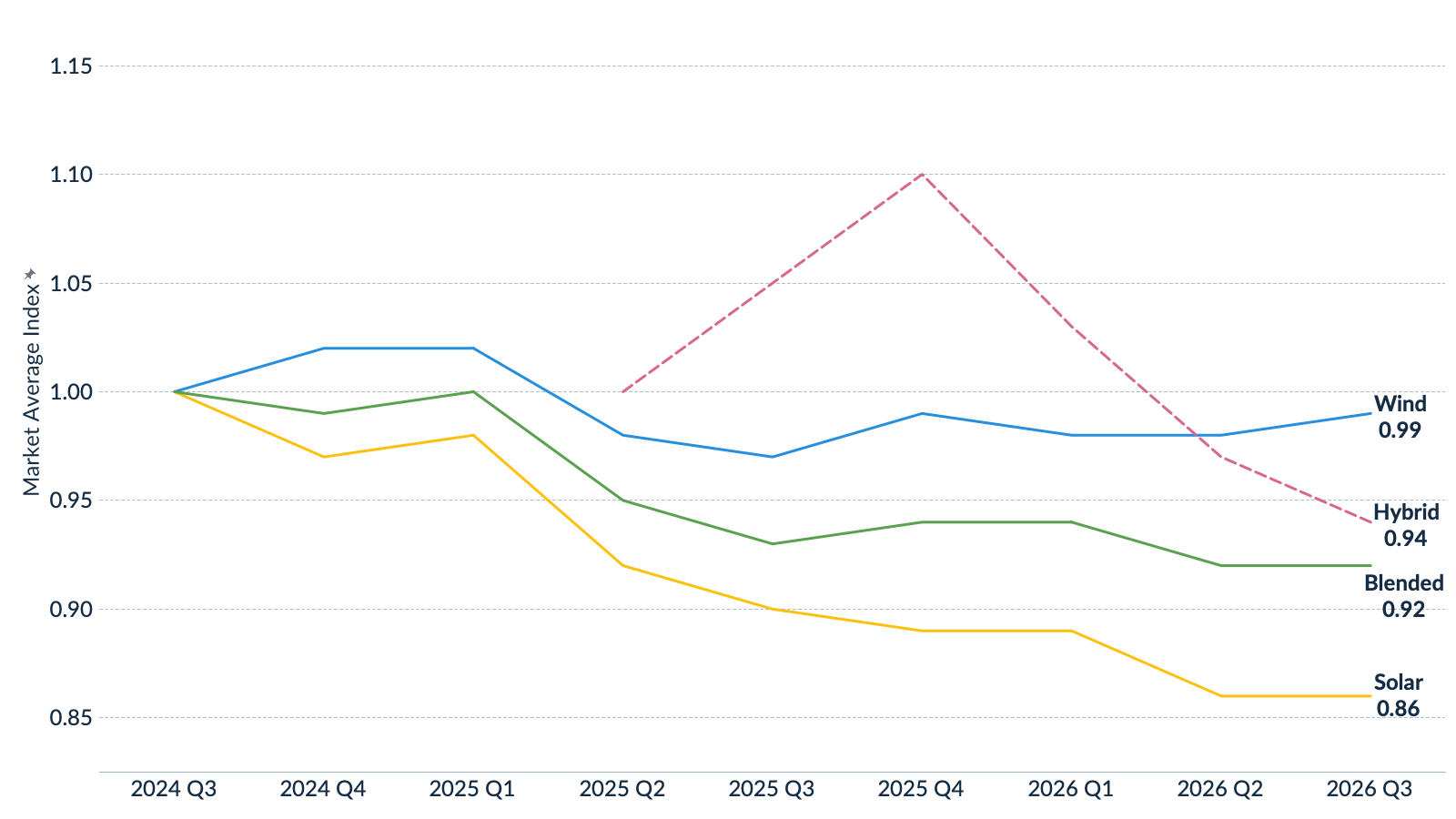
Wind prices reached 0.99 in this quarter’s index – 99% of their Q3 2024 price level. This follows a steady recovery in wind prices from late 2025 onwards, following a sharp price drop for both wind and solar PPAs in the preceding 12 months.
“This quarter’s data confirms the price premium that wind holds over solar in many markets. This is explained by the higher value that a wind PPA offers to buyers in most markets with high solar buildout.” said Ostos. “With solar cannibalisation continuing to apply downward pressure on midday captured prices, wind's potential 24-hour generation profile means it often provides higher value to buyers across the tenor of a PPA. This means that wind PPAs are less exposed to the same market forces pushing down prices that solar deals are experiencing.”
Previous research by LevelTen Energy revealed that PPA offers for wind power were almost twice as likely to be selected by buyers than solar-only offers.
Spain remains Europe's lowest-priced market for solar PPAs, with a P25 of €30.93/MWh – down 1.2% since last quarter and 7.7% from last year. It is also Europe's largest solar offer pool on the LevelTen Platform, hosting more than a third of all solar offers. Seller competition is high in Spain, with LevelTen seeing real-world negotiations there range closer to the market's P10 value, which rests in the sub-€30 range.
The quantity of Spanish offers for new-build standalone solar has fallen sharply, as intense cannibalisation pushes developers towards pairing solar with battery storage. Spain's hybrid P25 rose 6.8% to €48.00/MWh in the LevelTen Hybrid Index, about €17/MWh above standalone solar prices, with Spain and Portugal together accounting for nearly half of all hybrid offers in Europe.
In Germany, the P25 of hybrid price offers fell by 12.7% to €65.50/MWh this quarter – the largest decline among all markets on the LevelTen Hybrid Index. With battery costs falling and new hybrid contract structures increasingly recognised as bankable and transactable by market players, hybrid PPAs have become a powerful tool to hedge against volatile power prices.
Pieter van der Meulen, Country Manager for Germany at LevelTen Energy, said: “The case for hybrid PPAs in Germany is strong. The country still needs a major expansion of solar to meet its 2030 renewable energy targets, but with high numbers of negative-price hours and rapid PV buildout, standalone solar is getting harder to finance. Pairing it with storage allows developers to move power output into the evening demand peak, and lets buyers sign a more predictable product with a shaped generation profile.
“Historically low gas-storage levels highlight the urgency of this hybridisation drive. Every megawatt-hour of solar delivered in the evening via battery storage is one less that depends on gas. For buyers, a hybrid PPA means a more predictable product with a shaped generation profile, and a hedge against winter price spikes.”
LevelTen Energy is the industry’s largest renewable PPA marketplace, with participation from 1,300+ project developers, 50+ energy advisors and resellers, and the world’s largest clean energy buyers.