
Corporate buyers are facing down a simple fact: as of February 1, 2027, SBTi participants will become unable to use RECs secured in markets outside their grid regions of operation to comply with SBTi standards.
Amid ongoing changes to voluntary frameworks, including the Science Based Targets initiative (SBTi) and Greenhouse Gas Protocol (GHGP), uncertainty has been pervasive, and many corporate sustainability departments have adopted a "wait and see" approach. However, given the short time window for signing deals that will conform to less stringent, legacy SBTi standards, there is a strong argument for immediate action. But what options are available to corporate buyers looking to seize the moment?
What we know
Those compelled to act are asking themselves: What do we actually know? When it comes to reporting guidelines, we need to rely on the SBTi V2.0, the only major framework that has been finalized. Cognizant of their symbiotic relationship, the SBTi and GHGP have made multiple public statements emphasizing their collaborative relationship and commitment to the "interoperability" of their final standards. For those looking to take action, the new SBTi standard is a useful proxy to understand how the GHGP may ultimately play out.
SBTi guidance is expansive. Below are some of the most salient updates to SBTi V2.0 that professionals focused on Scope 2 emissions need to know about:
- Physical deliverability: A profound shift, SBTi V2.0 requires participating corporates to procure clean power attributes in their relevant "activity pools." For Scope 2 purposes, activity pools refer to "the serving their electricity consumption" (CNZS V2: C30.1). Intuitively, these deliverability regions might be assumed to be the ISOs/RTOs and the relevant balancing authorities in which corporates physically operate — but more clarification from SBTi and the final GHGP guidance will likely be needed. Either way, these tighter procurement boundaries mark a profound shift that will require significant adjustments from PPA players.
- No hourly matching: A major SBTi V2.0 takeaway is the omission of an hourly-matching requirement for EACs. An hourly-matching proposal was included in last year's GHGP draft, and experienced substantial pushback during Q4 2025's public consultation period. However, SBTi V2.0 does require companies with more than 10 GWh of annual electricity consumption to report their hourly electricity usage, beginning in 2030.
- Removal of emissions-intensity targets: SBTi V2.0 removes the option to set and address emissions on an "emissions intensity" basis, which measures emissions relative to economic or operational outputs. Going forward, all participants must focus on reducing "absolute emissions," the literal amount of emissions released due to their operations.
- Separation of Scope 1 and 2 emissions: The previous SBTi framework allowed companies to combine their Scope 1 and 2 emissions into a single category. SBTi V2.0 requires their separation, removing the option to mitigate Scope 1 impacts via PPAs (as one example of prior workarounds).
- New company categories: The legacy SBTi framework took a "one-size-fits-all" approach in which most corporate participants were treated the same, with the exception of small- to medium-sized entities ("SMEs") which were beholden to more lax standards. SBTi V2.0 introduces two new categories: Type "A" and "B" companies, which are defined here.
- New facility age limits: Under SBTi V2.0, EACs must be sourced from facilities that have been operational for no more than 15 years. However, this age limit is removed in the case of PPAs signed with facilities that have been operational for less than 36 months as of the time of contract finalization.
The clock is ticking
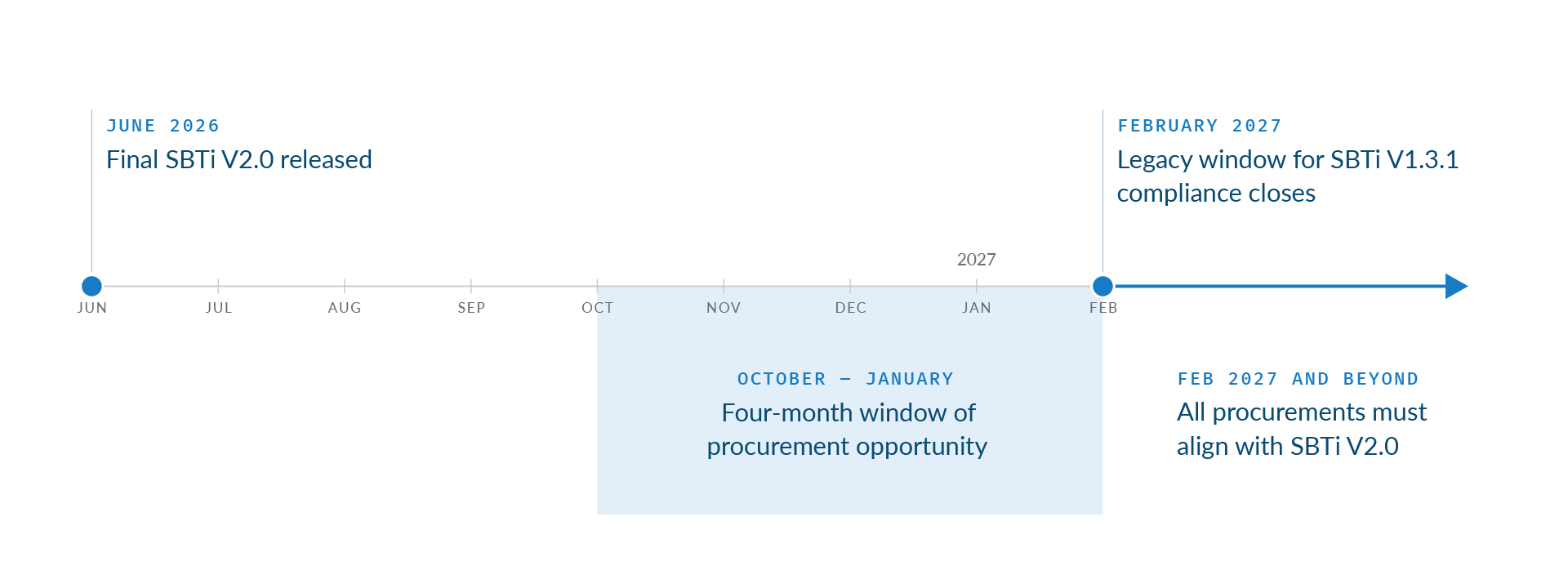
SBTi V2.0 kicks into effect for all 10,000+ participating corporates on February 1, 2028. And while the new SBTi guidance is robust, there has been some degree of trepidation around interim dates.
Specifically, the nature of legacy clauses has been a point of scrutiny and concern. Section A.5 of SBTi V2.0 guidance states "Existing contracts will be grandfathered for the duration of the contract, meaning they will not need to meet new requirements." V2.0's Legacy Clause, from section C30.5, provides specifics around the timelines at play: "Market instruments from existing long-term contracts prior to the effective date of the Corporate Net-Zero Standard V2.0 may be considered deliverable in the same activity pools the instruments were applied to before the effective date."
What is this "effective date" for SBTi 2.0? While January 31, 2028 is the final date companies can submit targets under the old SBTi standard, the legacy date for procurements differs. Long-term procurements executed prior to February 1, 2027 can be counted under SBTi 1.3.1; procurements executed after that date will need to adhere to SBTi 2.0 requirements, including physical deliverability.
In other words, in less than five months, using RECs secured via Virtual PPAs in markets outside participants' deliverability regions will no longer be a viable strategy for corporate buyers looking to address Scope 2 emissions in a manner aligned with SBTi standards.
Take the fast lane
While the window for action is indeed short, there is no need for premature surrender. Years of LevelTen expertise and procurement innovation have yielded several contracting approaches that can bring buyers to signed PPAs with great speed. Here are your fast lanes:
Bilateral PPAs
LevelTen provides access to unprecedented PPA supply with granular project-level data that allows buyers to skip the RFP process entirely. Once a buyer's needs have been identified, LevelTen can connect you directly with a shortlist of qualified, ready-to-transact projects. LevelTen publishes a monthly digest of top projects primed for bilateral deals for corporate buyers. Sign-up to receive this digest here.
Easy VPPA
For enterprises with smaller procurement volume needs, Easy VPPA combines economies of scale with lightning speed. Leveraging Constellation's industry-leading access to clean power, Easy VPPAs provide an aggregated PPA opportunity that only requires buyers to buy a ticket and board. As of this blog's publication, an ERCOT-focused Easy VPPAs process is ongoing, with the required procurement threshold drawing near. Reach out soon to make sure the train doesn't leave without you.
LEAP
Larger buyers that are clear on their needs use LevelTen's LEAP™ process to accelerate the traditional RFP process by as much as five-fold. LEAP buyers have secured more than 5 GW of capacity via LevelTen, with the average time from RFP to signed PPAs standing at 95 days (compare that with the industry average of more than 350 days for typical C&I procurements). LEAP continues to allow sophisticated buyers to procure at scale with unprecedented speed.
Decisiveness drives impact
Organizations don't always have every piece of information they'd like before making decisions. But recent KPMG research substantiates the bottom-line benefits of acting with decisiveness, even in imperfect conditions, and LevelTen's own analysis also illustrates the downsides of waiting to procure. During the height of the pandemic's inflationary pressures and the energy market impacts of Russia's invasion of Ukraine, some buyers chose to sit on the sidelines and wait for safer seas. Today, many of them are still waiting for that stability as policy and energy-market volatility persist. If it is true that disruption is the new normal for energy markets (which it certainly appears to be), waiting on the sidelines is tantamount to strategic surrender.
Don't regret not taking decisive action while the window was still open. Buyers are seven times more likely to close a deal using LevelTen compared to going it alone. Leverage the industry's largest network and most advanced transactional capabilities to make smart strategic choices, today.
Fill out the form below to connect with our team and turn aspirations into action, today.
.jpg)