
Key Takeaways:
- PPAs have demonstrated an ability to balance corporate electricity costs by offsetting increases in retail electricity rates, capturing financing upside during periods of market turmoil, and beating out inflation by locking in nominal prices.
- Using real-world historical data, LevelTen's analysis shows that buyers that signed PPAs in ERCOT and PJM six years ago were positioned advantageously with respect to navigating energy-market shocks, rising grid costs, and the impacts of extreme weather events.
- As geopolitical, energy-system, and climate uncertainties persist, the case for signing PPAs today to mitigate future market challenges remains compelling.
Power purchase agreements (PPAs) have enabled corporate buyers to support more than 143 GW of new-build clean energy capacity since 2014 — more than the peak power demand of California and Texas, combined. By enabling grid decarbonization and producing the RECs corporate buyers seek while providing developers with critical financing support, PPAs have been a major win-win for both sides of the renewables market.
Sustainability motives have traditionally been the primary driver for corporate buyers pursuing clean energy contracts. But as volatility in energy markets and economic uncertainty have grown, more buyers are seeing an opportunity to use PPAs as a means of improving stability and certainty within their broader financial and energy strategies.
Stability and Sustainability
The historical focus on the environmental benefits of PPAs has perhaps overshadowed other advantages they can bring for balancing a company's energy expenses. While it is generally true that sustainability-focused renewables buyers haven't been going to market seeking economic upside, some noticeable co-benefits of their environmental leadership have nonetheless materialized.
The US energy system is at a noteworthy crossroads. An aging grid is facing a surge in load growth due to data center expansion, ongoing electrification, the onshoring of manufacturing, and more. Adapting the grid to meet this growing demand requires substantial investments in new generation, transmission, and distribution — while also storm-hardening the existing grid as more extreme weather damages infrastructure. The reality is that the costs to utilities of meeting these needs are eventually rolled into retail bills for residential, commercial, and industrial consumers. In this era of energy market volatility and geopolitical shocks, hedging to stabilize corporate energy expenditure has become vastly more important.
C&I buyers generally use retail contracts to lock in electricity prices, typically for periods of one to three years. While these contracts can feel like a shelter from market storms, any safe haven is short-lived compared to the energy-sector volatility that is expected to last well past decade's end. Data from the US Energy Information Administration (EIA) shows that commercial retail rates rose by 5% nationally between 2025 and 2026. Price increases have been particularly robust in PJM, where explosive data center growth and a capacity crunch have caused searing price hikes, while the grid's independent market monitor raises alarm bells around capacity shortfalls that may portend more rate trouble.
As anticipated grid challenges become real-world impacts, there is little reason to believe retail rate increases will moderate any time soon. The good news is, PPAs can mitigate exposure to multiple energy and geopolitical risks — here's how:
Finding Balance
For corporate buyers, signing a PPA introduces a resilient fixed component in their overall energy expenditure. PPAs that last a decade or longer can meaningfully offset price increases across a company's portfolio of retail contracts (which typically last 1–3 years) by counteracting volatility in the wholesale power market. This isn't because they balance out such volatility in real-time (they don't). Rather, it's because upward price pressures in wholesale markets are eventually incorporated into retail rate increases, while PPA prices remain stable.
PPAs typically capture financial upside during high-priced periods in wholesale power markets via their fixed-for-floating structure. This means that when wholesale power prices spike and utility rates increase, PPAs can help cover any costs incurred by securing revenues from these same price spikes. A PPA essentially functions as a long-term proxy hedge — a bet on a fixed PPA price that may be higher than average retail rates initially, but is likely to beat them out in the long run as the costs of ongoing grid upgrades are incorporated every time retail rates reset.
Without PPAs to counteract rising retail rates, corporates are left far more exposed to the mounting costs associated with grid modernization, tightening capacity margins, and more. And volatility doesn't just mean higher prices; it also means bigger price swings, which are harder to anticipate and account for. PPAs help smooth the overall impact of these swings on corporate energy budgets — so while PPA buyers give up some of the immediate benefits of low grid prices, their overall energy costs also don't spike as much in return.
Shelter From the Storm
A well-calibrated strategy that balances retail contracts and PPAs is a tried-and-true approach to stabilizing corporate energy costs. But the value of fixed-price contracts grows all the more apparent during moments of unforeseen market or geopolitical events.
The last several years have provided no shortage of examples. Texas' 2021 Winter Storm Uri and Russia's 2022 invasion of Ukraine provide two instances of unanticipated occurrences that roiled energy markets. As we'll see, corporate buyers with PPAs in place were positioned advantageously with respect to navigating these market shocks.
Inflation has also acted as a persistent underlying headwind for corporates since 2021. But here, too, PPAs added stability and certainty in a turbulent world. Since most PPAs are signed in nominal terms, they essentially become cheaper over time as surrounding inflation pushes the price of everything else up — including energy. As inflation remains stubbornly above desired levels moving into H2 2026, protection from these broader price pressures provides yet another compelling reason for corporates to sign PPAs now.
The Proof Is in the PPA
Historical data allows us to see exactly how PPAs have supported pricing stability in the real world. To do this, LevelTen’s analytics team assessed how a representative solar PPA, signed by a major commercial buyer in 2020, would have fared financially over the last six years in two major markets: PJM and ERCOT. As we'll see, the results emphatically underscore PPAs' ability to stabilize overall electricity expenditure.
While we appreciate that 2020 P25 PPA prices might elicit eyerolls from some readers, the radical price changes over the last six years further underscores how PPAs can outlast the impacts of macro phenomena occurring in the world more broadly. As federal tax credits for wind and solar projects begin to dwindle, 2026's PPA prices may one day come to be viewed with equivalent incredulity.
Supported in PJM
Serving more than 67 million customers across 13 states, PJM is the nation's largest grid operator. As mentioned, the market is experiencing no shortage of challenges, and retail rates are being adjusted upward at a sturdy pace.
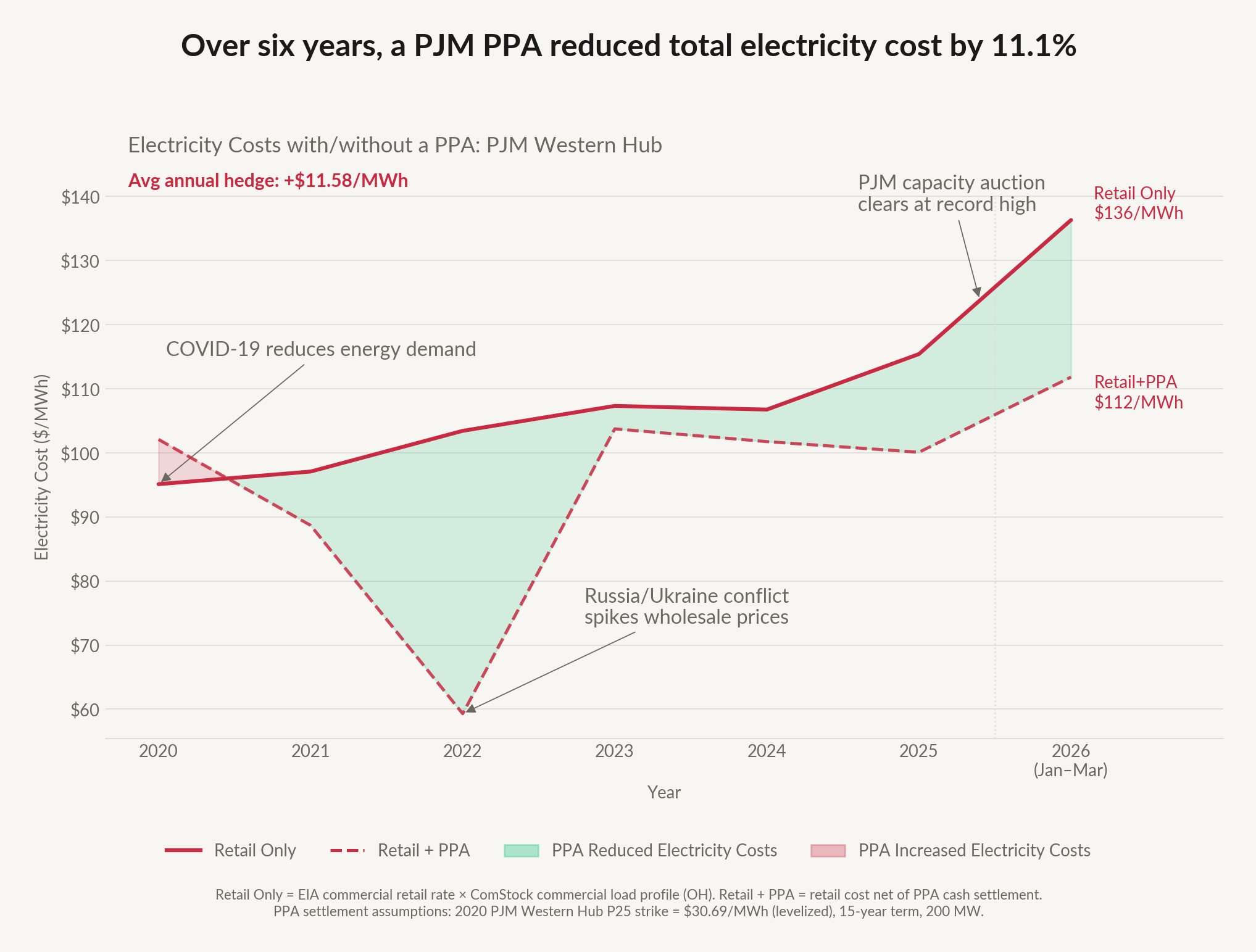
In PJM, the PPA's value during unexpected events is illustrated clearly. In 2022, Russia's invasion of Ukraine led to global gas shortages that spiked power prices at home, resulting in upside for the PPA. A larger delta is also visible beginning around 2025, when PJM's capacity shortage — and the costs of addressing it — became more apparent. The PPA's value was enhanced during moments of geopolitical shock, as well as when structural grid challenges applied pressure to wholesale power markets. Over six years, the PPA reduced total electricity costs by an average of $11.58 per MWh — a savings of more than 11% when compared to a retail-only approach.
Protected in Texas
Texas' ERCOT grid is unique in many respects. Physically isolated from other interconnections, the market essentially functions as an energy island. It also has no capacity market, and has experienced a phenomenal rate of renewable energy buildout in recent years amid robust levels of corporate PPA procurement.
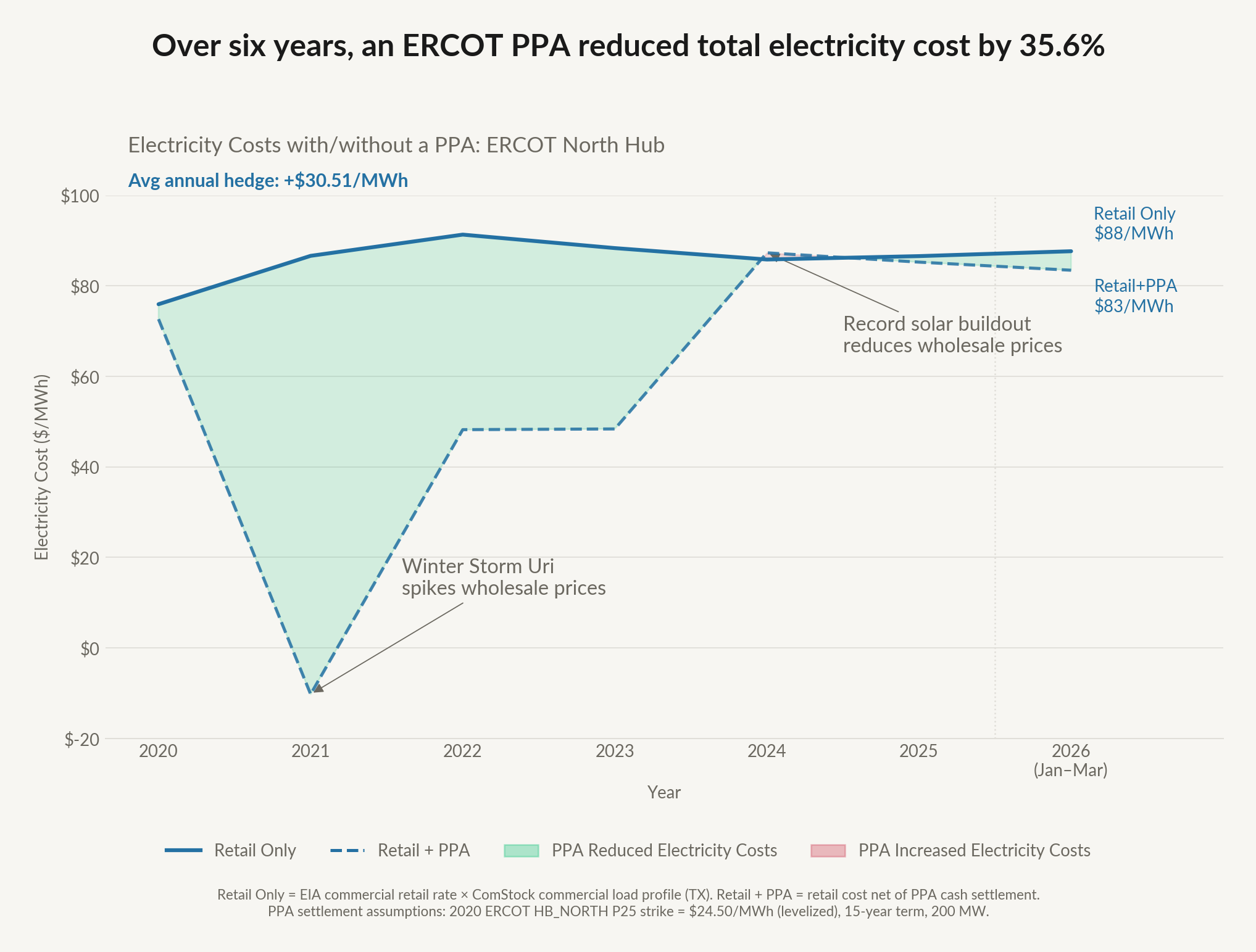
February 2021's severe winter storm, colloquially termed "Uri," caused rolling blackouts across the state, causing sky-high wholesale power prices. Entities with signed PPAs were able to capture upside during the wholesale market impacts of Uri and its aftereffects, providing a very clear example of how extreme pricing events can affect PPA settlements.
Over six years, the PPA reduced total electricity costs by an average of $30.51 per MWh — saving more than 35% compared to a retail-only approach. The convergence of the graph's dotted and solid lines beginning around 2024 show the effects of growing solar penetration in Texas on wholesale power prices as abundant PV generation increasingly drives down daytime spot prices. However, as we'll discuss, these low wholesale prices may not be here to stay.
While it is true that ERCOT solar capacity has exploded, policy and market-based headwinds could begin to slow the rate of renewable buildout there in the next few years, with a growing wave of high-cost thermal generators slated to come online. These thermal units bring far higher CapEx and exposure to volatile fuel prices — which will be paid by ratepayers in the long run. More thermal units operating also means these higher-priced generators will be more likely to set the marginal price for electricity, pushing up power prices as demand surges.
Coupled with fast-growing demand, energy prices in the Lone Star State could rise substantially in the coming years. As data center buildout, electrification, and manufacturing growth add new load across the state, ERCOT has predicted that peak demand in the market could more than quadruple by 2032. Even if only a fraction of this expected demand growth materializes, the wholesale (and, by extension, retail) pricing impacts would likely be significant.
A March 2026 analysis from the EIA noted a remarkable spread in predicted wholesale market prices for ERCOT in 2027. A high-demand scenario showed the potential to boost wholesale prices by an eye-popping 78.9% over the EIA's base case (for comparison, the second-highest difference between these two cases was ISO-New England, with a 5.3% spread). These numbers underscore just how unpredictable the future of power production and consumption is in ERCOT, and how the market's unique design and pricing mechanisms make extreme prices more likely. Layer on top of that the potential for more severe weather events, and the uncertainty compounds further.
Anyone with operational solar PPAs in ERCOT right now will tell you that contract settlements there are dynamic, and not always positive. But immense change can occur over 15 years, and there is no better example of where the nature of that change is more uncertain than Texas. With many indicators pointing to much higher wholesale prices down the road, LevelTen is still seeing significant buyer appetite to sign PPAs in ERCOT, even amid ongoing market uncertainty.
Expect the Unexpected
These analyses drive home just how much PPAs can help buyers better weather unforeseen events and beat retail rate hikes over the long run. Now, at the nexus of seismic energy-system change, substantial geopolitical uncertainty, and extreme weather events that are growing more common, corporate entities must be decisive in how they plan to navigate the challenges of tomorrow.
In May, the North American Electric Reliability Corp. (NERC) issued its highest alert, raising alarm around the grid-stability risks associated with growing data center loads. Meanwhile, energy leaders at March's CERAWeek gathering concurred that "disruption is the new normal" for energy markets, while the International Monetary Fund (IMF) recently cautioned that the world should prepare for more economic shocks.
PPAs frequently look more expensive compared to commercial or industrial retail rates. But as unpredictable energy, meteorological, and economic events mount, maintaining an undiversified corporate energy strategy could grow increasingly costly. LevelTen Energy and our network are here to support your team in identifying and transacting for the best PPA opportunities, balancing your retail and PPA contracts to maximize outcomes, and monitoring PPA portfolio performance. If you're ready to take action to help ensure your organization's future success, fill out the form below to connect with our team.
Methodological note:
The analyses above use state-specific retail electricity rates for the commercial sector provided by the US Energy Information Administration (EIA). To model consumption, load profiles from NREL's ComStock dataset were used. To understand PPA performance, we used actual hourly electricity prices for each market: ERCOT's North Hub Settlement Point Prices, and PJM's Western Hub Day-Ahead LMPs. The PPAs modeled are based on the average 2020 P25 prices for solar in the respective Hubs modeled, with the underlying projects having nameplate capacities of 200 MW, and representative 8760s in each hub, over a 15-year contract term.
.jpg)