.png)

In May 2026, clean energy leaders from across Europe gathered in Madrid for the fourth edition of the LevelTen Energy Forum.
With over 150 attendees from across the industry in attendance, the event provided a platform for clean energy buyers, developers, advisors and utility representatives to share experiences and identify a path forwards through current market challenges.

Here are four key learnings from the event.
1. The day-ahead market has ceased to be a reliable investment signal.

Market volatility has increased across Europe, becoming a significant investment signal for clean energy market players.
The opening panel at the Forum brought together Nicholas Byrne, Energy Market Commercial Advisor at Hitachi Energy; Pablo Martínez, Country Manager at Modo Energy; Giovanni Scomparin, Advisor at Eurelectric; and Ryan Alexander, Head of Global Strategic and Market Intelligence at Enspired, to dissect the stark realities of Europe's shifting power markets.
The panel highlighted several critical dynamics shaping future investments via long-term contracts:
Price spreads are widening.
The daily price spread in European markets has jumped by at least 30% every year for the past three years, fueled largely by solar cannibalisation causing deep midday price dips. This provides financial opportunity for battery arbitrage, but brings headaches for buyers with solar-heavy portfolios.
The day-ahead market doesn’t provide investment signals anymore
It was also highlighted that, while in the past the day-ahead market was essentially the only price signal – serving both as investment and operational signal – the change in the industry has split both signals. The day-ahead market remains as a highly efficient operational tool, yet it has ceased to be a reliable investment signal for capital-intensive investments such as renewables. Hence the need for a strong PPA market.
Battery cannibalisation is real, but non-linear.
Battery Energy Storage Systems (BESS) bite the hand that feeds them: while capturing revenue from widening price spreads, they are also compressing those price spreads in many markets as buildout progresses. Mature markets like Great Britain have already seen rapid revenue compression in ancillary services, and similar signs are beginning to emerge in Spain. However, this cannibalisation isn't linear. The flexibility inherent to batteries allows the asset to quickly adapt to change its focus according to system needs. For instance, the two-hour battery portfolios in Germany which were making 75% of their revenues from ancillary services 18 months ago have now seen that rise to 85%.
The day-ahead market provides a financial anchor
The panel included a warning that value in limited-liquidity segments such as ancillary services can collapse rapidly once a critical mass of flexible assets enters the grid. When these market areas saturate, the deep liquidity of the day-ahead market remains the anchor for hedges such as day-ahead swaps.
“Anyone who's investing in this space is putting a bet on climate goals fundamentally, because we're not going to stop building out solar tomorrow. There's a natural hedge: if you're worried about being long on volatility, then go into solar, and then you can find ways to mitigate that risk, whether it's physically or financially.”
Ryan Alexander, Head of Strategic and Market Intelligence at Enspired
2. Virtual storage deals and hybrid PPAs are unlocking new paths to battery project finance.
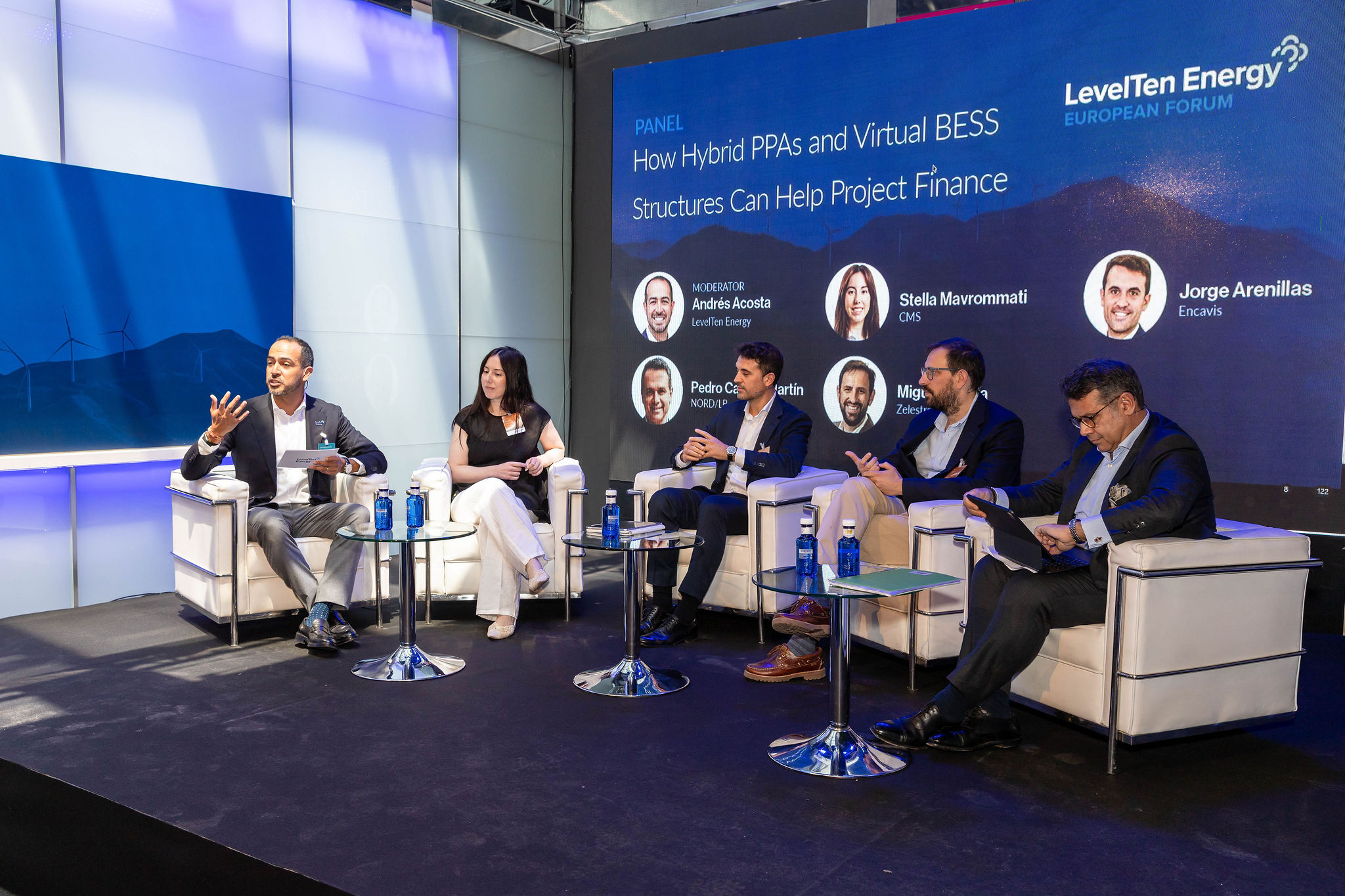
As battery buildout accelerates, the financial mechanisms underpinning them are undergoing a rapid evolution. Andrés Acosta, Director of Innovation and Head of Europe at LevelTen Energy, gathered a panel of experts – Miguel García, Product Director in Spain at Zelestra; Pedro Capote Martín, Senior Director at NORD/LB; Stella Mavrommati, Senior Associate, Energy & Climate Change, at CMS UK; and Jorge Arenillas, Managing Director at Encavis – to discuss how the industry can bridge the gap between revenue security and contract complexity to get storage projects successfully financed.
The panel outlined several key themes driving the next generation of clean energy financing:
Virtual and flexible structures have a crucial role to play.
While physical tolling agreements and floors remain highly desired for revenue certainty, the future market cannot rely on them exclusively due to a limited pool of tolling offtakers. By 2030, partial tolls and financial structures such as virtual hybrid PPAs, virtual tolls and day-ahead swaps will be widely used tools to provide market upside while maintaining bankability.
Financial structures should be standard and transparent.
Financial structures like day-ahead swaps do not have to be overly complicated and can be standardised once counterparties align on commercial principles. The current hurdle is ensuring both buyers and financing banks fully understand the risk allocation within these new frameworks.
Different structures require careful management of risk.
Financing financial structures requires mitigating potential basis risk. Because physical asset delivery does not dictate floating leg payments in a day-ahead swap, banks must look closely at how optimisers manage real-world operational risks like grid curtailment and battery state-of-charge management.
Supporting offtakers to meet credit-rating criteria will unlock more deals.
A major talking point for project finance is that many market optimisers lack formal investment-grade ratings. To satisfy bank credit committees, developers are successfully utilising credit enhancements, such as Letters of Credit or Parent Company Guarantees (PCGs), to allow unrated but financially strong counterparties to anchor project portfolios.
“The main thing that you need to nail when you're talking about day-ahead swaps in the context of project financing is potential basis risk. Because when it comes to these structures, the physical reality of the asset does not matter for the payment of the floating leg. And that's key to keeping it simple, but at the same time, you need to make sure that you understand how the risk is managed.”
Stella Mavrommati, Senior Associate (Energy & Climate Change) at CMS UK
3. As the market grows more complex, corporate buyers prioritise simplicity.

As market dynamics grow increasingly intricate, the contractual clauses anchoring PPAs are undergoing their own evolution. Max Plumptre, Transactions Director at LevelTen Energy Europe, hosted a panel to uncover the negotiation strategies required to get sophisticated, multi-technology deals across the finish line. Joining the panel were: Héctor Suárez, Counsel at Watson Farley & Williams; Terence de Pentheny O’Kelly, Partner at ERM Coho; Silvia Escudero Santos-Ascarza, Head of Upstream Origination, Statkraft; and Albrecht Zimmermann, Director Energy Procurement, Carlsberg.
The discussion illuminated a structural divergence in how different market participants approach risk, complexity, and contract design:
Price has given way to value.
The traditional European model of pay-as-produced PPAs, where the generator gets paid for every MW they inject into the grid, is rapidly changing. Instead, price has given way to value: the ability of an asset to provide flexibility, and to tap into a complex revenue stack that blends PPA settlements with battery optimisation, ancillary services, and imbalance reduction.
Corporate buyers prioritise simplicity.
While developers optimise for complex revenue streams, corporate buyers value simplicity above all else: predictability, fixed profiles, and “no ugly surprises." The more complexity and risk that the seller or an intermediary can shoulder on behalf of the buyer, the better.
As well as managing complexity, sellers can leverage it to optimise returns.
As revenue stacks grow more diverse and PPAs increasingly combine multiple technologies, sellers can use complex strategies to optimise asset performance while still providing corporate buyers with simple, standardised products. However, utilities and buyers with sophisticated energy trading departments are likely to want to play in that space as well, potentially leading to more moving parts in the PPA negotiation regarding risk allocation and revenue shares.
Multi-technology deals force a rethink of traditional PPA clauses.
Traditional provisions like negative pricing and force majeure are facing greater scrutiny. With hybrid projects, legal teams must now grapple with the risk of partial facility disruptions, such as a force majeure event affecting a battery asset but leaving the co-located solar array operational. Furthermore, the market is steadily moving away from complex availability guarantees in favour of more manageable production guarantees, driven partly by IFRS treatment of PPAs. On top of all that, adding a new asset to a project in the form of BESS brings different performance guarantees tied to different metrics, such as round-trip efficiency, cycle limits, and degradation. These are relatively novel metrics which markets are not yet well versed in.
Future carbon accounting rules are likely to impact future – not closed – deals.
Anticipated revisions to voluntary sustainability standards are expected to tighten the criteria around GOs. Contracts negotiated in the coming years may need to proactively factor in stricter temporal matching and geographic co-location requirements for make-whole volume shortfalls, though grandfather clauses should protect agreements made before the changes take effect.
“Buyers are simple players in this type of market... We are happy to accept certain risks, commit to a long-term offtake, often at fixed prices, to help the energy industry build new things. That's our role. How that is actually then implemented is not our role, that's your role. My role is to brew beer and keep costs in control, and provide a risk-bearing capacity.”
Albrecht Zimmermann, Director Energy Procurement at Carlsberg Group
4. Storage deals are already gaining traction.
Although there remains a lot of progress to be made in terms of market education around hybrid PPAs and storage deal types, these structures are beginning to gain traction in European energy markets.
Sofía Reguero, Transactions Manager at LevelTen Energy, sat down with Martin Degen, Senior Manager Energy & Sustainability at data centre provider Digital Realty, to discuss their experience of procuring clean energy via a standalone TBx storage deal on the LevelTen Energy Marketplace.
Digital Realty has achieved 100% renewable energy in Europe, and was not seeking more volume with this project, but flexibility. The capability of battery storage to hedge against the performance of an existing solar PPA was a key factor. Martin highlighted the importance of running an request for proposals (RFP), especially for a new product like TBx, to introduce competition to the process and avoid overpaying.
With so many variables involved in such a structure, the conversation highlighted how important the LevelTen platform has been in providing in-depth portfolio analysis, and stress-testing offers against a combination of long-term price forecasts. With many of the offers backed by projects still under development, the development maturity metric provided by LevelTen also helped to quantify risks.
“The mismatch in solar production versus our consumption, which is very much flat baseload, is not ideal. We knew that was the case, but it links to an aspect that has changed positively: batteries. Now there is a potential solution to help us with the profile mismatch.”
Martin Degen, Senior Manager Energy & Sustainability at Digital Realty
LevelTen is the leading provider of transaction infrastructure for the clean energy transition, connecting buyers, sellers, and financiers through dynamic marketplaces, data-driven insights, and automated analytics.
Interested in exploring how advanced PPA and battery storage procurement strategies can benefit your organisation? Contact info@leveltenenergy.com to learn more about our platform and solutions.
.jpg)